White, black, and gray continue to account for nearly three-quarters of vehicles produced globally, according to Axalta’s 73rd annual Global Automotive Color Popularity Report, released this week. But for collision repair shops, the more operationally significant finding may be buried in the details: The vast majority of those neutral-colored vehicles use effect or pearl finishes that require multi-stage refinish processes and precise color matching.
The 2025 report, based on comprehensive automotive build data across major markets, found white leading at 29%, followed by black at 23% and gray at 22%. Silver continued its decline at 7%, while blue held steady at 6% as the strongest chromatic color globally. Green, which Axalta highlighted when it named Evergreen Sprint as its Global Automotive Color of the Year earlier this year, held at 3% globally but showed notable regional variation.
“This year’s report reveals how enduring neutrals continue to anchor the global palette, even as interest rises in finishes that bring greater depth, movement, and individuality to vehicle styling,” said Dr. Lei Qiao, vice president of technology for mobility coatings at Axalta.
Effect finishes complicate ‘simple’ colors
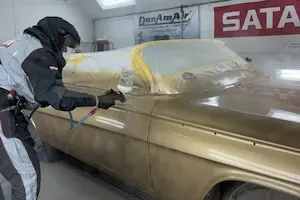
The report’s breakdown of solid versus effect finishes within each color category carries direct implications for refinish operations. Among black vehicles globally, 19% use effect finishes, compared with just 4% that are solid black. That means approximately four out of five black vehicles require complex color matching rather than a straightforward solid-color repair.
White vehicles show a similar pattern: 15% of white vehicles globally use pearl finishes, with that figure rising to 17% in North America. These multi-stage finishes demand additional materials, labor time, and technician expertise to match correctly.
For shop owners evaluating paint department efficiency, this data suggests that even a workflow dominated by neutral colors doesn’t translate to simplified refinish work. The prevalence of effect and pearl finishes across the neutral palette means color-matching technology and skilled painters remain essential regardless of which colors are most common.
North America sees chromatic colors rising
While neutrals dominate, North American shops should note a gradual shift toward chromatic colors that adds another layer of complexity. Blue reached 10% of North American vehicle production, nearly double the 6% global average, while red held at 7%.
The full North American breakdown shows white at 31%, gray at 21%, black at 19%, blue at 10%, silver at 8%, red at 7%, green at 2%, and yellow/gold and brown/beige each at 1%.
This chromatic growth reflects what Axalta describes as drivers increasingly choosing bolder colors as part of a broader cultural shift toward customization and standout styling. For shops, a higher chromatic share means maintaining a broader inventory and investing in color-matching tools that can handle a wider range of formulations.
Regional variations worth watching
Shops serving diverse customer bases or operating across multiple markets may find value in the report’s regional breakdowns. Europe stands alone with gray as the leading color at 26%, followed by white at 25%, and black at 22%. South America shows a stronger preference for silver at 14%, while Asia demonstrates a growing appetite for expressive colors, with yellow/gold at 4% and green at 3%.
Perhaps most notable is South Korea, which reported green at 8% of production, nearly three times the global average. That could signal emerging preferences that may eventually reach North American consumers.
China’s data shows black leading at 28%, with white close behind at 27%, but the finish breakdown is telling: 24% of Chinese vehicles use black effect finishes versus just 4% solid black, reinforcing that effect finishes have become the norm rather than the exception.
Implications for inventory and technology
The data supports a continued focus on neutral-color inventory while highlighting the need for sophisticated color-matching capabilities. Shops can reasonably expect that white, black, and gray formulations will constitute the majority of their refinish work but should plan for the complexity that effect and pearl finishes add to that workload.
More than one in five shops now report billing insurers for spectrophotometer or color camera use, according to the “Who Pays for What?” survey conducted by Collision Advice and CRASH Network. That’s a practice this color data supports. When the majority of even neutral-colored vehicles require effect-finish matching, the labor and technology investment deserves appropriate compensation.
Dr. Robert Roop, Axalta’s senior vice president and chief technology officer, noted that the company’s resin chemistry enables the development of coatings that meet diverse color demands across different customers, cultures, and climates while ensuring durability and performance.
For collision repair operations, the 2025 color data reinforces that refinish work continues to grow more complex, even as the dominant colors remain familiar. Shops investing in digital color tools, technician training, and appropriate billing practices position themselves to handle that complexity profitably.
The full 2025 Global Automotive Color