Open any industry publication right now and you'll see the same message: waterborne is the future. Low-VOC coatings, compliant basecoat systems, facility conversions. The entire refinish conversation has been heading in one direction for the better part of 20 years.
But the shop floor tells a different story.
While the industry continues to evolve, solvent-borne is still the reality for the majority of U.S. shops. Somewhere between 60% and 80% of collision repair shops in the U.S. are still spraying solvent-borne basecoats every single day. Several major manufacturers have even recently introduced new solvent-borne basecoat lines, bringing fresh formulations and updated chemistry to a segment of the market that's still very much active.
But here's the issue: while most painters are still spraying solvent-borne products, the equipment industry has spent the last two decades engineering almost exclusively for waterborne. And that disconnect is costing painters time, materials, and finish quality in ways many of them don't realize.
How Solvent and Waterborne Atomize Differently
Since around 2005, there has been a singular focus when it comes to spray guns: improving atomization for waterborne coatings. That makes sense, because waterborne is harder to atomize well.
Think of it this way. The resins in a solvent-borne basecoat are like a bowl of broth with short noodles, small molecular chains that break apart easily. Waterborne resins are more like a bowl of tangled spaghetti.
It takes significantly more energy at the air cap to break those longer chains into fine, evenly distributed droplets. So, today's premium guns produce large, high-energy spray patterns, often 10.5 to 12 inches tall, specifically engineered to deliver that energy.
The result is a generation of spray guns that are genuinely excellent for waterborne. But all that atomization power can actually work against you when you're spraying solvent-borne basecoat.
Why Over-Atomization Strips Solvent Before It Hits the Panel
Solvent-borne coatings form a film differently than waterborne. They depend on wetting the panel, creating a specific wet film that lets metallic and pearl flakes orient themselves naturally while the material is still liquid. The paint needs to arrive on the surface with enough solvent still in it to flow, connect with adjacent droplets, and coalesce into a smooth film.
When a painter takes a gun built for waterborne atomization and sprays solvent-borne basecoat through it, that high-energy air cap strips too much solvent from the material before it ever hits the panel. The droplets land drier than they should. Instead of connecting into a continuous film, they sit as individual beads that partially flatten but never fully merge.
The result is mottle. Metallics stand up instead of laying flat, so colors read lighter than they should. Pearl orientation goes inconsistent. Even a highly skilled painter ends up fighting the finish. Drop coats become a crutch. Blends get harder. Rework eats cycle time.
The problem isn't the painter's technique. It's not the paint. It's a mismatch between the equipment and the material.
Shop Floor Insight: If you're getting good results with your premium gun on waterborne basecoat but fighting mottle and metallic issues every time you spray solvent-borne, the gun isn't broken. It's just not designed for that chemistry. Solvent performs best with a shorter, wider pattern, typically 8 to 10 inches, that provides the right wetting for clean metallic orientation without rework.
None of this is an argument that solvent is better than waterborne. Waterborne has real advantages — lower emissions, strong color matching on certain colors, and continued investment from paint companies developing new waterborne systems. For shops in regulated areas or those already invested in waterborne infrastructure, it's an excellent technology.
The point is simpler: the two chemistries have different physics at the air cap, and equipment should match what you're actually spraying.
What Speed Clears Are Doing to Your Spray Pattern
There's another place this equipment mismatch shows up, and it's getting more common as shops push for faster throughput: low-viscosity clearcoats AND speed clears.
It's worth noting that clearcoats are already almost universally solvent-borne across the industry. It's the basecoat side where the solvent versus waterborne divide really plays out. But certain clearcoats, particularly low-viscosity speed clears, present their own equipment challenges.
Speed clears are engineered to dry fast. On a 70-degree day, a painter can put down two coats and have the panel ready to sand and polish in about 45 minutes, compared with six to eight hours or longer for a traditional clearcoat to air dry. For shops without heated booths, or any shop trying to turn the booth faster, that's a real production advantage.
But the speed comes from chemistry. These clears use shorter resin chains and lower viscosity so solvent can escape the film quickly. When mixed, they often measure under 20 seconds through a DIN 4 viscosity cup, sometimes as low as 14 to 16 seconds. Most painters can feel the difference just stirring the material.
The In-Flight Solvent Loss Trap
That low viscosity makes speed clears exceptionally sensitive to atomization. Spray one with a standard high-pressure setup, especially through a gun producing a big, high-energy pattern, and the material gets over-atomized. Too much solvent evaporates between the gun and the panel, a process called in-flight solvent loss. What lands on the surface is drier and higher in solids content than it's supposed to be.
The natural instinct is to compensate: slow down, push the gun closer, try to force the material to wet out. But that creates new problems. Because the material lost solvent during atomization, it's building thicker than intended. A thick clearcoat film cures slower, and the performance characteristics the paint company engineered into the product start to break down.
The other common move is to lower the inlet air pressure. That does reduce atomization energy, but it also changes the spray pattern. The air horns on the cap are what stretch the round output into a tall, parallel-sided fan shape. Reduce the air too much and that shape collapses into a football, and the even overlap that produces a consistent finish falls apart. You've traded one problem for another.
Practical Test: If you find yourself constantly dialing down pressure on certain clearcoats and still fighting dry spots or blown-out pattern centers, that's a strong signal your gun isn't optimized for low-viscosity materials. The equipment should be able to maintain a balanced, even pattern at lower pressures, typically 20 to 26 psi for speed clears, without sacrificing shape.
Your Spray Style Matters More with Solvent
Not all painters work the same way, and that matters more with solvent-borne than it does with waterborne.
Some painters work close to the panel with fast arm speed and heavy overlap. Others stand further back, slower and more controlled. Neither is wrong. But with waterborne, the high atomization energy somewhat levels those differences. The gun is doing so much work breaking up the droplets that technique variations are more forgiving.
With solvent-borne basecoat, the relationship between pattern shape, arm speed, and wetting is much more direct. A gun that complements a painter's natural style, rather than forcing adaptation, is one of the biggest factors in getting clean, mottle-free results.
On technology choice: HVLP tends to be the more forgiving option for solvent-borne basecoat, delivering reliable consistency with fewer variables to manage. RP offers faster working speed and is widely preferred for clearcoat.
For painters looking for a single gun to handle the full system (sealer, basecoat, and clearcoat), RP with a 1.3 nozzle is the sweet spot. It handles sealer and clearcoat exceptionally well, and with the right technique, delivers strong basecoat results too.
On nozzle size: the vast majority of solvent-borne basecoats, low-VOC solvent basecoats, standard and low-viscosity clearcoats spray well through a 1.3 or 1.4. It's that straightforward.
Choosing The Right Gun For the Right Job
Spray guns are a real investment, and painters, especially those early in their careers, are conscious of what they are getting for their spend. That's practical, not a shortcoming.
Today's premium platforms offer full nozzle ranges from 1.1 to 1.6, multiple pattern shapes, and engineering tuned for the most demanding waterborne applications. For painters spraying across every coating technology, that versatility has value.
But for painters whose daily work is primarily solvent-borne basecoats and clearcoats, that breadth of capability may not be necessary. Since solvent-borne and low-viscosity products spray well through just a 1.3 or 1.4, a purpose-built gun can deliver performance specifically matched to these coatings. It's not a compromise. It's the right tool for the job.
Who Benefits Most From a Purpose-Built Gun
That value equation plays out across several real-world scenarios.
For preppers doing jamb work in the prep deck, a durable, high-quality gun at an accessible price point is the ideal workhorse. For painters just out of vocational school, it provides a professional-grade tool that handles sealer, basecoat, and clearcoat without a huge upfront cost. It lets them start earning while they build out the rest of their toolbox.
Starting with the right equipment also means building good habits from day one. Painters who learn on tools that fight them develop workarounds that become ingrained, and those are hard to unlearn later. A gun that works with the coatings rather than against them shortens the learning curve and sets a new painter up for long-term success.
Shop Floor Insight: The right question isn't "what's the best gun?" It's "what's the best gun for what I'm actually spraying?" If the answer is solvent-borne basecoats and clearcoats, purpose-built equipment will outperform a more expensive gun that wasn't designed with those coatings in mind.
Match the Tool to the Chemistry
The collision repair industry will keep evolving toward waterborne and low-VOC. That's real, it's important, and it's not slowing down. But for the majority of shops still running solvent-borne, and running it well, the takeaway isn't that you're behind. It's that you should have equipment actually engineered for the coatings you use.
The right tool means fewer extra coats of basecoat to get the metallic orientation right. Less clearcoat laid on heavy to bury texture issues. Less time on rework. Those efficiencies add up: less material waste, faster cycle times, and a painter who trusts what's coming off the gun.
5 Questions to Ask Before Your Next Spray Gun Purchase
1. What am I spraying most? If solvent-borne basecoat makes up the majority of your work, your gun should be engineered for that chemistry, not adapted from a waterborne platform.
2. Am I fighting my finishes? Consistent mottle on solvent-borne basecoat, blown-out patterns on speed clears, or heavy reliance on drop coats are all signals of an equipment-to-material mismatch.
3. Do I need full nozzle versatility, or am I in the 1.3 to 1.4 range? If you're spraying solvent-borne and low-viscosity products, you likely don't need the full 1.1 to 1.6 range that premium platforms offer.
4. Am I buying for what I spray today? A premium waterborne-optimized gun is a great investment if you're spraying waterborne. If you're not, it may be more gun than you need, and the wrong gun for the coatings you actually use.
5. What support comes with the purchase? A $150 gun from a big-box retailer has no field support, no paint company partnerships, and no one to call when you need help dialing in a setup. Equipment backed by dedicated technical support pays for itself in the long run.
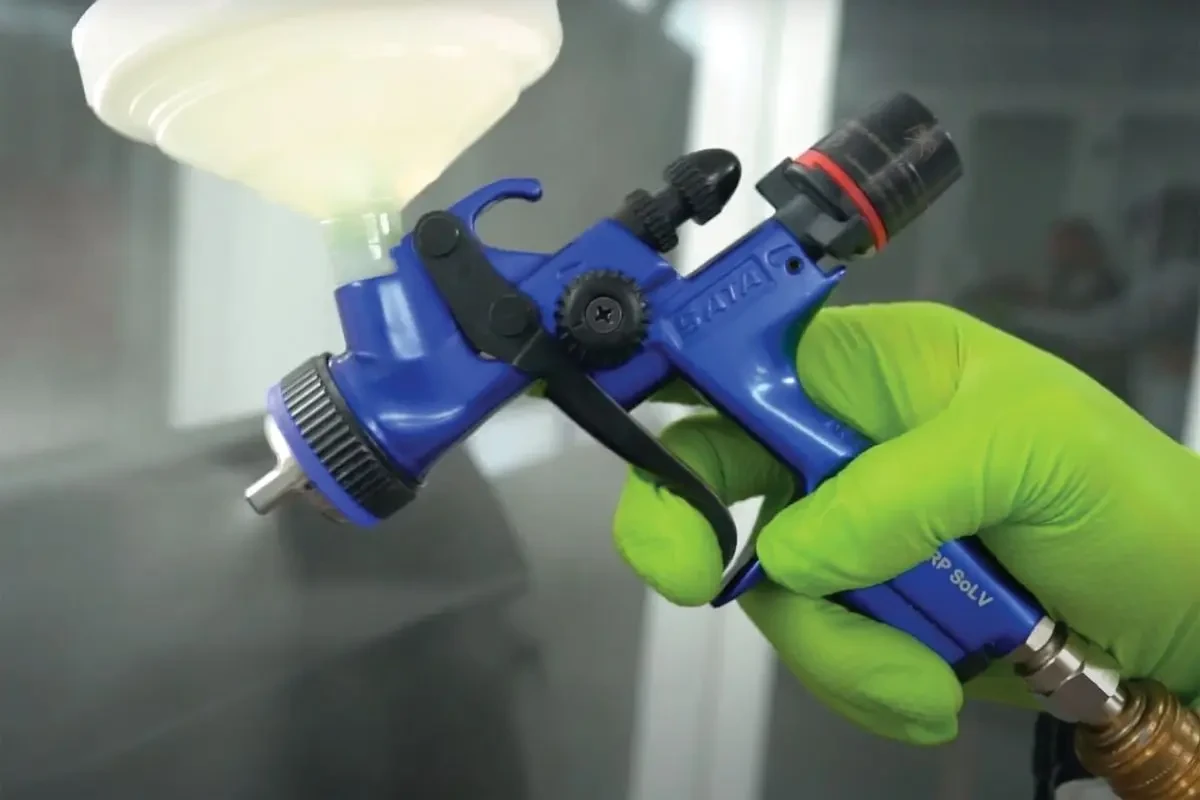
If you've been dealing with these challenges — mottle on solvent-borne basecoats, blown-out patterns on speed clears, or just looking for a purpose-built workhorse that handles the full solvent system — the SATAjet 1500 B SoLV was designed for exactly this. The name tells the story: Solvent, Low VOC, and Low Viscosity.
Visit sata.com or ask your local SATA distributor about adding the SATAjet 1500 B SoLV to your lineup.